The stratigraphic model
An integral part of the application's modeling workflow is defining a stratigraphic model. The stratigraphic model links two important aspects of geological modeling:
- The stratigraphy of the units (often formations and members) identified in the model area.
- The available data describing the bounding surfaces between those units.
The stratigraphic model should be constructed early in the modeling process, as a collaborative tool to ensure all disciplines are aligned on how their data will be incorporated into the geological model. Stratigraphic correlation establishes connectivity in a reservoir model. Also, the stratigraphic model influences the fluid model definition and the structural model building sequence. After the stratigraphic model is defined, it determines how units will relate to each other vertically as well as laterally, once they are constructed in 3D in the structural model.
A characteristic element of the stratigraphic model in JewelSuite Subsurface Modeling is its use of hierarchy in the form of stratigraphic ‘levels’. The hierarchical concept supports a set of parent child relationships, where one parent can have multiple children, but a child can only have one parent (see image further below, where an example is given for the North Sea Brent Group). The hierarchical concept of the stratigraphic model has clear advantages during the various modeling stages:
- Stratigraphy is hierarchical, which can be reflected in the stratigraphic model. Higher order units constrain the lower order units during construction of the internal zonation of the 3D geological model. This concept is absent in most other modeling packages.
- JewelSuite Subsurface Modeling allows upfront definition of hierarchy which can be used to guide data interpretation.
- Well correlation is more robust; lower order units are typically identified during (local) well correlation and can be placed in the context of higher order seismic (regional) interpretations.
- Structural modeling can be performed in stages: higher order stratigraphic units (seismic resolution scale) can be created first, allowing early QC steps and giving control over data resolution, before adding more detail in the form of flow simulation models.
Hierarchical levels in the stratigraphic model support the lithostratigraphic concept commonly known as the Group-Formation-Member relationship, which is relevant in most reservoir modeling studies, where rocks are described using their gross lithological characteristics and named according to their rank in this formal hierarchy. In many reservoir field studies, a typical hierarchical stratigraphic scheme combines the regional (group and/or formation) stratigraphy with local production allocation and reservoir modeling zones at deeper levels. Irrespective of the approach, the stratigraphic model forms the framework for various types of modeling purposes, such as structural models, fluid flow models or geomechanical models.
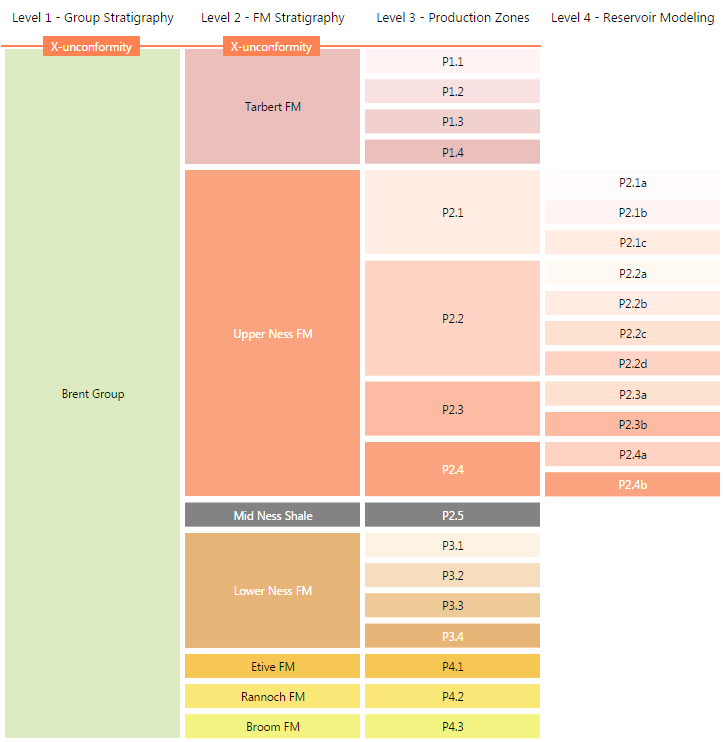
Example of a stratigraphic model created in JewelSuite Subsurface Modeling. The vertical columns represent the levels of the hierarchical framework, combining regional stratigraphy with local production units click to enlarge